a short story by Awen Null
The Hollow Circuit // Fiction Signal 01
The
Witnesses
A psychological dystopia about authorship, surveillance, and the small, casual jokes that become a country’s next infrastructure.
Content note: intrusive surveillance, psychological distress, and a world in which privacy becomes evidence of guilt.
By 2030, people had stopped saying “privacy” in public.
Not because it was illegal. Not yet. It was simply a word that made rooms uncomfortable, like mentioning an old friend who had died badly.
Mara said it anyway.
“Privacy,” she said, wrapping both hands around her mug. “It’s funny. It sounds filthy now.”
Jon laughed through his nose. He was sitting opposite her in the yellowish wash of the kitchen light, one socked foot hooked over the other knee. Outside, rain ticked at the window in small, nervous fingernails.
“Say it again,” he said.
“Privacy.”
“God. You’re right. It sounds like a disease. ‘I’m sorry, your father’s taken a turn. The privacy’s spread to his lungs.’”
Mara laughed. Properly laughed, with tea in her mouth and her shoulders shaking. Some of it went up her nose. Jon raised his mug to her in solemn acknowledgement.
“To the privacy wards,” he said. “May they be underfunded and impossible to access.”
“To confidentiality,” Mara said.
“To being trusted for no fucking reason at all.”
They clinked mugs.
On the shelf above the cooker, the Home Witness showed a soft green light.
Neither of them noticed it blink.
The Home Witness had been installed eighteen months earlier, during the second phase of the National Authenticity Programme. At first it had been optional, supposedly. It sat on the wall like a small smoke detector, white and featureless except for its lens. The government called it a domestic integrity node. The companies that made them called them Witnesses, because people liked the word. It sounded old-fashioned. Biblical. Solid.
A witness was someone who had seen.
A witness was someone you wanted on your side.
The original adverts had been gentle.
A child’s voice in a darkened bedroom: “Mum says this was my first word.”
Then a woman laughing over old home footage. Then a man, crying on a sofa, saying: “When they said I hadn’t been there, I could prove I was.”
The camera lingered on his face.
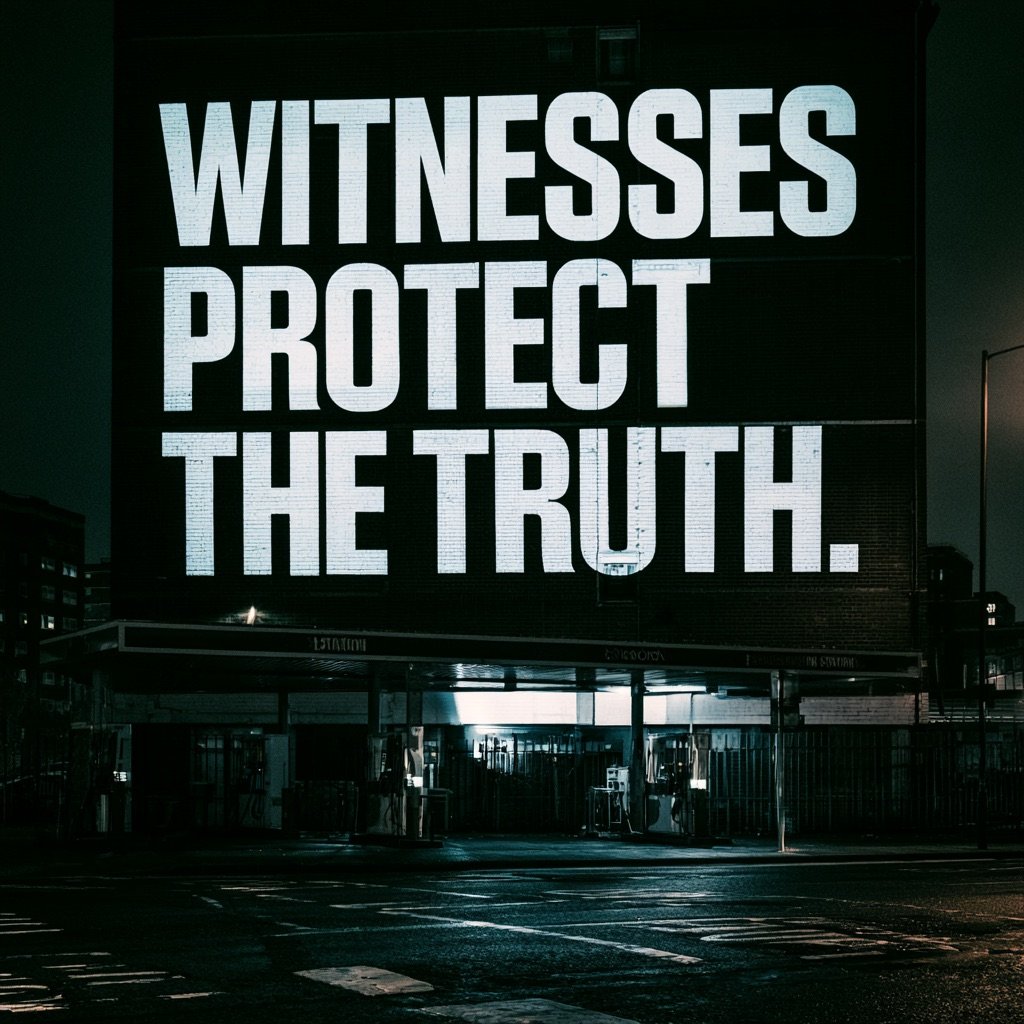
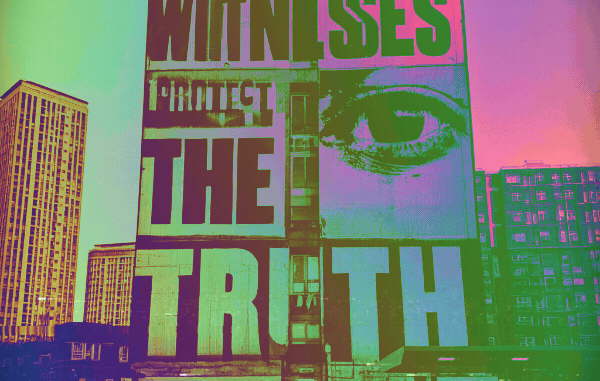
“Witnesses protect the truth.”
The slogan had appeared everywhere: in train stations, above petrol pumps, between songs on streaming services. It had been painted in giant letters down the side of a housing block in Croydon.
TRUTH SHOULD NOT DEPEND ON MEMORY.
People liked it. At first.
Mara had liked it, if she was honest. That was the worst part.
She worked from home, building visual systems for small artists and independent labels who wanted their releases to look less like advertising and more like small haunted worlds. She knew what it was to have your work copied, lifted, remade by a machine in five seconds and posted by someone else with a neat little signature at the bottom.
She understood the hunger for proof.
Everyone did.
The first scandals were simple. A singer said a label had made her use an AI voice double. The label said she was lying. A developer was accused of using generated art in a game funded by people who had pledged specifically against it. A novelist was offered a deal so large that the number had travelled around the world before the book had been properly read, and then no one could establish where the words had come from.
Not who had typed them.
Where they had come from.
The distinction became everything.
By the time Mara’s work started getting rejected by platforms unless she submitted process footage, she barely complained. It was annoying, but so was tax. So was two-factor authentication. So was listening to people explain blockchain.
She bought a wrist camera.
She recorded herself sketching. Recording herself adjusting the sketch. Recording herself deleting the first sketch because it looked too much like someone else’s work. She recorded herself swearing at a client brief. She recorded herself drinking wine while looking at an empty canvas and doing nothing for forty-three minutes.
The platform marked it all as human process.
A little blue badge appeared next to her name.
Verified Origin.
She felt proud.
That was the part she could never forgive.
Jon tapped the side of his mug with one finger. “I read that they’re bringing in live provenance for books.”
Mara looked up. “What does that even mean?”
“It means authors have to write in front of an approved system.” He made a rectangle with his hands. “Screen capture, eye tracking, keystrokes, probably a little biometric thing to make sure you aren’t swapping with an identical twin.”
“Identical twins are so fucking lazy.”
“Yeah. If you’re going to commit literary fraud, at least invent a clone.”
“They’ll have to livestream the whole thing. Twenty-four hours a day. Write under candlelight. Prove your worth.”
Jon smiled. “Carrier pigeon submissions only.”
“Pen and ink. Wax seal. Family crest. Maybe a blood sample.”
“Blood is easy to fake.”
“Then a witness.”
They both went quiet for a second.
It had been a joke. It should have stayed one.
Mara looked at the green light above the cooker.
“Does that thing hear us?” she asked.
Jon glanced up. “Of course it hears us.”
“I mean, does it hear us hear us?”
“That’s the question, isn’t it?”
There was a sound from the hallway.
Not a loud sound. Just the soft electronic chime of a system recognising a voice.
Mara stared at the closed kitchen door.
Jon said, “Probably the fridge.”
“The fridge doesn’t chime.”
“Everything chimes now.”
The Home Witness light changed from green to amber.
They watched it together.
Then, after three long seconds, it returned to green.
Jon put his mug down. “It’s probably a firmware update.”
“Don’t say firmware update like that makes it better.”
“It makes it boring.”
“Boring is what they call things while they’re happening.”
He opened his mouth to reply, but his phone buzzed on the table.
The screen lit his face from below.
They both stared at it.
Then Jon laughed.
It was too loud. It went on for too long.
“Oh, fuck off,” he said. “That’s not real.”
Mara’s phone buzzed next.
She did not touch it.
Jon leaned across the table. “Open it.”
“You open yours.”
“I did.”
“What does it say?”
His smile disappeared.
Mara took her phone and held it face-down against her chest.
“What does it say?”
Jon swallowed. “It says it’s a reminder. A wellbeing reminder.”
“Read it.”
He looked at the screen again.
“‘Public anxiety about verification systems can be a sign of misinformation exposure. Your local trust liaison is available to discuss concerns.’”
Mara felt something cold move behind her ribs.
Her phone buzzed a second time, hard against her palm. She turned it over. The message was almost identical. At the bottom was a button:Continuation // Registry record
The next morning, Mara woke to an email from the Authenticity Registry.
She did not remember signing up to the Registry. She knew she must have. Everyone did eventually. A streaming service wanted it. A bank wanted it. Her health provider had started offering a discount if patients linked their Wellbeing Timeline. Her landlord had given her a reduction on contents insurance because the flat had a Home Witness installed.
The email thanked her for contributing to public confidence.
It included a clip.
She watched herself sleep.
For eleven minutes.
The footage was from the corner of her bedroom. It had no sound. Her body lay curled under the duvet. Every few minutes she twitched. Once, she sat bolt upright, eyes open, and looked directly into the camera.
She had no memory of doing it.
At the end of the clip, an annotation appeared.
NO ACTION REQUIRED.
She smashed her phone against the wall.
The screen shattered but stayed lit.
For a second, beneath the cracked glass, she saw herself reflected in black. Her face, pale and warped by the fractures.
Then the front camera activated.
A red dot appeared.
She left the flat.
She walked without her phone, without her watch, without the little audio clipper she wore on her coat when she was working. She left everything electronic in a drawer except the building fob, because the door would not open without it.
The lift had a camera.
The lobby had three.
The street had the new lampposts, their dark glass panels angled down towards the pavement. At the bus stop, the advertising screen turned to face her. It had been playing a trailer for a romantic comedy. Now it showed a soothing blue field and a sentence in white letters.
WE SEE YOU, SO YOU CAN BE SEEN.
Mara turned away.
Across the road, a man walked his dog. The dog stopped, cocked its head at a bin, then lifted its leg. The bin thanked it in a warm female voice for maintaining community hygiene.
She kept walking.
Every shop window contained her in some form. Reflected in the glass. Caught in the convex dome above a door. Repeated on the security monitor behind the counter, a smaller version of herself moving through a smaller version of the world.
A woman sat on a bench speaking quietly into her sleeve.
Mara slowed.
The woman looked up at her.
“You shouldn’t whisper,” she said.
Mara stopped.
“What?”
The woman’s eyes were raw-rimmed. Her hair was tied back badly, as if she had done it in the dark.
“They don’t like it,” she said. “Whispering makes the confidence score drop. Speak normally. Smile if you can.”
“I don’t know what you mean.”
The woman pointed over Mara’s shoulder.
At first, Mara saw nothing. Then she saw the screen inside the pharmacy window.
It was split into six panels.
A man buying toothpaste.
A child crying in a pushchair.
Two teenagers sharing a vape behind a bus shelter.
Mara herself, standing on the pavement.
Along the bottom, names scrolled.
Not names exactly. Identity hashes. Long strings of letters and numbers. Beside each one, a live status.
DOMESTIC FEED: AVAILABLE
PROVENANCE CONTINUITY: INTACT
Mara’s hash was highlighted in yellow.
The woman on the bench stood abruptly. “It’s all right,” she said. “We’re being looked after.”
Then she walked away.
Continuation // Live domestic feed
Mara went home before dusk because she did not know where else to go.
The building entrance opened before she held up her fob. The lift was waiting. Her flat door unlocked at her approach.
Inside, every screen was on.
Her television.
Her laptop.
The old tablet she used only for drawing.
The smart speaker in the corner, which she had unplugged months ago but which now pulsed a quiet blue.
Even the black glass of the microwave showed light.
They all displayed the same thing.
Her bedroom.
Her own bed, from the impossible high corner.
The live feed showed her standing in the living room, small in the doorway. She could see the back of her head. Her shoulders. Her hands hanging stupidly by her sides.
TRANSPARENCY IS CARE
She walked into the bedroom.
There was no camera in the corner.
There was no camera anywhere.
She checked the smoke alarm. The light fitting. The curtain rail. The mirror. She stood on the bed and pressed her face close to the ceiling.
Nothing.
Behind her, on the television in the other room, she heard a sound.
Her own voice.
Not speaking.
Breathing.
She ran back into the living room.
The screens had changed.
Now they showed her mother’s house in Leeds.
Her mother at the kitchen table, asleep in a chair. Her mother’s face was grey beneath the flicker of a television. Her mother’s hands were folded in her lap like she was waiting to be photographed.
Mara began to cry.
The feed shifted again.
Jon’s kitchen.
Jon sat exactly where he had been the night before. The mug was back in his hand. The light was the same bad yellow. The Home Witness glowed above the cooker.
But Jon was not laughing.
He was looking up at it.
His mouth moved.
Mara turned the volume up.
At first, there was only static. Then his voice came through, thin and ruined.
“I confirm,” he said. “I confirm I feel safe with the truth.”
The screen froze on his face.
A new message appeared.
THANK YOU FOR CONTINUING TO PARTICIPATE.
Mara stared at her own reflection in the dark edges of the screen.
Then, slowly, because she could no longer bear not to know, she looked directly at the place where the bedroom camera should have been.
And somewhere inside the wall, something blinked green.